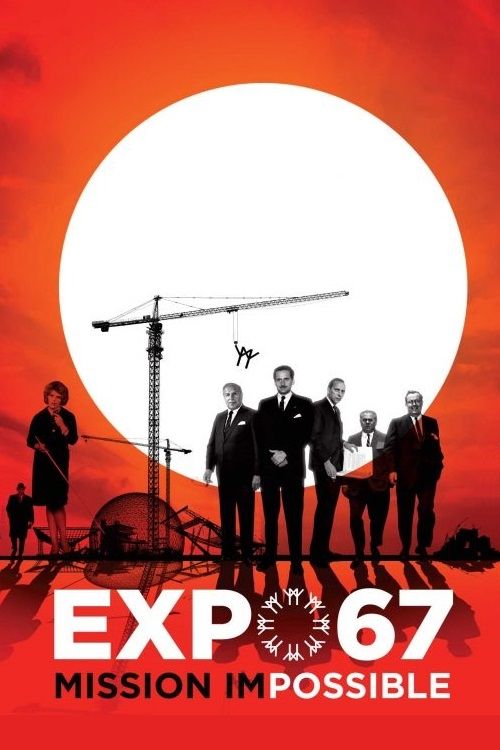
EXPO 67 Mission Impossible
Apr 25, 2017 | IMDB 7
68 min Watch NowDocumentary, History
This documentary let us to relive the challenge of the men behind the 1967 Universal Exposition in Montréal, Canada. By searching trough 80,000 archival documents at the national Archives, they managed to bring light on one of the biggest logistical and political challenges that were faced by organizers during the "Révolution Tranquille" in the Québec sixties. Includes the accounts of the Chief of Advertising Yves Jasmin, and businessman Philippe de Gaspé Beaubien.
MOVIE COMMENTS
SIMILAR MOVIES
Martha of the North
Honour to Senator Murray Sinclair
Sam's Army
The Battle of Vimy Ridge
The Last 100 Days
The Story Of (Scotty) The T. Rex
Crossing the Divide
Women in the Shadows
Snowflakes at the End of the World
La langue est donc une histoire d'amour
Man Belongs to the Earth
Hochelaga, Land of Souls
Brussels Loops
Just Watch Me: Trudeau and the 70's Generation
Trick or Treaty?
Les Mathématiques du Roi Heenok
Beyond Kicks
Breaking Point: Canada/Quebec - The 1995 Referendum
Bowling for Columbine
A World on Display: The St. Louis World's Fair of 1904
SIMILAR MOVIES
Martha of the North
IMDB 0 | Jan , 2009
In the mid-1950s, lured by false promises of a better life, Inuit families were displaced by the Canadian government and left to their own devices in the Far North. In this icy desert realm, Martha Flaherty and her family lived through one of Canadian history’s most sombre and little-known episodes.Honour to Senator Murray Sinclair
IMDB 9 | Sep , 2021
Murray Sinclair's acceptance speech for an award in honor of his role as chair of the Truth and Reconciliation Commission of Canada, intercut with the testimonies of survivors of the Indian residential school system.Sam's Army
IMDB 10 | Mar , 1999
Canada was led to war by a bigoted, ignorant, self-obsessed Minister of Militia, who may well have been clinically insane, but the importance of Canada's contribution in that war owes a great deal to him. The man of course, was Colonel - later made Lieutenant General by his own hand - Sam Hughes. Sam's Army is a compelling portrait of a complex man and the formidable military he built. Sam Hughes was not your standard-issue military leader. Canada's World War I Minister of Militia and Defence concentrated power in his own hands, insisted that the Canadian military use the ill-conceived Ross rifle and liberally promoted his cronies. But there was no denying Hughes was a visionary. He assembled the world's largest-ever volunteer army and bucked superiors to keep his ferocious fighting force together in one Canadian Corps.The Battle of Vimy Ridge
IMDB 10 | Mar , 1999
A two-hour documentary which recreates for the viewer one of the greatest battles in Canadian military history. The film was made to show that Canadian character at its best, forging an identity for a country that before the First World War had been seen only as a British colony - an identity and a character that became recognized and respected throughout Europe.The Last 100 Days
IMDB 10 | Mar , 1999
Canadian military accomplishments in the last hundred days of World War I, when the German Army was destroyed, surpassed those of any other army. The Canadian success was, in no small measure, due to Arthur Currie, whom a recent British historian describes as "the most successful Allied General and one of the least well known."The Story Of (Scotty) The T. Rex
IMDB 0 | Nov , 2020
In this documentary, we go back to the beginning and tell the origin story of Scotty the T. Rex and how it was discovered on that fateful day in 1991. We also showcase the lasting impact the discovery had on the town of Eastend and the Paleo world in Canada. In 2019, Scotty was proclaimed the biggest in the world. Believed to be a female, she measured over 13 m or just over 42.6 feet long and weighed over 8.8 metric tons. Discovered in the dinosaur-rich Frenchman Formation, Scotty's bones have been carefully preserved and are stored at the T. Rex Discovery Centre in Eastend, Saskatchewan.Crossing the Divide
IMDB 0 | Apr , 2025
Two Canadians, one Liberal and one Conservative, attend a U.S. convention focused on depolarizing politics, determined to engage in tough conversations for a healthier democracy.Women in the Shadows
IMDB 0 | Jan , 1991
Filmed on location in Saskatchewan from the Qu'Appelle Valley to Hudson Bay, the documentary traces the filmmaker's quest for her Native foremothers in spite of the reluctance to speak about Native roots on the part of her relatives. The film articulates Métis women's experience with racism in both current and historical context, and examines the forces that pushed them into the shadows.Snowflakes at the End of the World
IMDB 0 | Nov , 2025
Snowflakes at the End of the World offers a meditation on the beauty and ugliness of Montreal winter, and invites critical reflection on the relationship between humans and nature.La langue est donc une histoire d'amour
IMDB 8 | Oct , 2019
Man Belongs to the Earth
IMDB 0 | May , 1974
Made for screening at the U.S. Pavilion at the 1974 World's Fair in Spokane Washington, USA, which had a Native-American environmental theme, MAN BELONGS TO THE EARTH depicts the history of air, water, and earth pollution, and how environmentalists are trying to solve these problems using various technologies.Hochelaga, Land of Souls
IMDB 5.1 | Sep , 2017
Mohawk archaeologist Baptiste Asigny engages in a search for his ancestors following a tragic terrain slump in the Percival Molson Stadium.Brussels Loops
IMDB 0 | Apr , 1958
A collection of twenty short films, averaging 2-3 minutes, by various filmmakers depicting American life, intended to be shown in a continuous loop at the American Pavilion of the 1958 Brussels World’s Fair. Some releases of the film include ten extra minutes of rough cuts.Just Watch Me: Trudeau and the 70's Generation
IMDB 0 | Sep , 1999
Canadian director Catherine Annau's debut work is a documentary about the legacy of Pierre Trudeau, the long-running Prime Minister of Canada, who governed during the 1970s. The film focuses particularly on Trudeau's goal of creating a thoroughly bilingual nation. Annau interviews eight people in their mid-30s on both sides of the linguistic divide. One tells of her life growing up in a community of hard-core Quebec separatists, while another, a yuppie from Toronto, recalls believing as a child that people in Montreal got drunk and had sex all day long. Annau has all of the interviewees discuss how Trudeau's policies affected their lives and their perceptions of the other side, in this issue that strikes to the heart of Canada's national identity.Trick or Treaty?
IMDB 0 | Sep , 2014
Legendary Canadian documentarian Alanis Obomsawin digs into the tangled history of Treaty 9 — the infamous 1905 agreement wherein First Nations communities relinquished sovereignty over their traditional territories — to reveal the deceptions and distortions which the document has been subjected to by successive governments seeking to deprive Canada’s First Peoples of their lands.Les Mathématiques du Roi Heenok
IMDB 7.8 | Jan , 2008
Beyond Kicks
IMDB 0 | Jan , 1972
In the early 1970s, a group of young volunteers, the Free Youth Clinic of Winnipeg, operated a "crisis bus" to rescue young people experiencing bad drug trips, usually from LSD.Breaking Point: Canada/Quebec - The 1995 Referendum
IMDB 10 | Oct , 2005
BREAKING POINT brings viewers back to those tense, critical moments when Canada's future as a country was at stake.Bowling for Columbine
IMDB 7.5 | Oct , 2002
This is not a film about gun control. It is a film about the fearful heart and soul of the United States, and the 280 million Americans lucky enough to have the right to a constitutionally protected Uzi. From a look at the Columbine High School security camera tapes to the home of Oscar-winning NRA President Charlton Heston, from a young man who makes homemade napalm with The Anarchist's Cookbook to the murder of a six-year-old girl by another six-year-old. Bowling for Columbine is a journey through the US, through our past, hoping to discover why our pursuit of happiness is so riddled with violence.A World on Display: The St. Louis World's Fair of 1904
IMDB 0 | Feb , 1994
Uses first-person accounts from Missourians who went to the Fair in 1904, interviews with historians, archival motion pictures, and photographs to situate the St. Louis Fair in the social, political, and cultural context of American society in 1904. Covers American civilization at the turn of the century; the representation of history; authenticity; modernity; dress and body language; oral history and childhood memories; world fairs as experiences; and receiving information through visual symbols, words, and exhibits.